Why Buy a Tiny House?
September 10, 2009

Why would you want to spend $15,000 to $50,000 on a little house when you could add a real addtion to your house and have a permanent improvement built right on to your existing house?
This article is assuming you are building a tiny house as an additional room along with your existing home.
Here are a few suggestions that may also get you thinking of other reasons this might apply for building that tiny house. You can than decide what would work best for you and your circumstances.
- Permits Costs: The cost of a permit has grown by leaps and bounds over the past few years. I want to give you an idea what an average permit will cost you today. In most places in the U.S. they range from $15,000 to $50,000. Just to add another room or addition to your existing home. Remember that is just to get a permit to build your addition.
- Permits may not be available at all: Some towns, cities and counties no longer will issue a permit. You are banned from any new construction or additions in some areas of the country. This takes the ability to add to your home completely out of your hands. The answer is NO!
- Permit Time: Once a permit is requested it can take up to one to two years to process. If you need a space addition right away, it won’t happen. It is necessary to plan way in advance and to know your needs are long before the construction can even start.
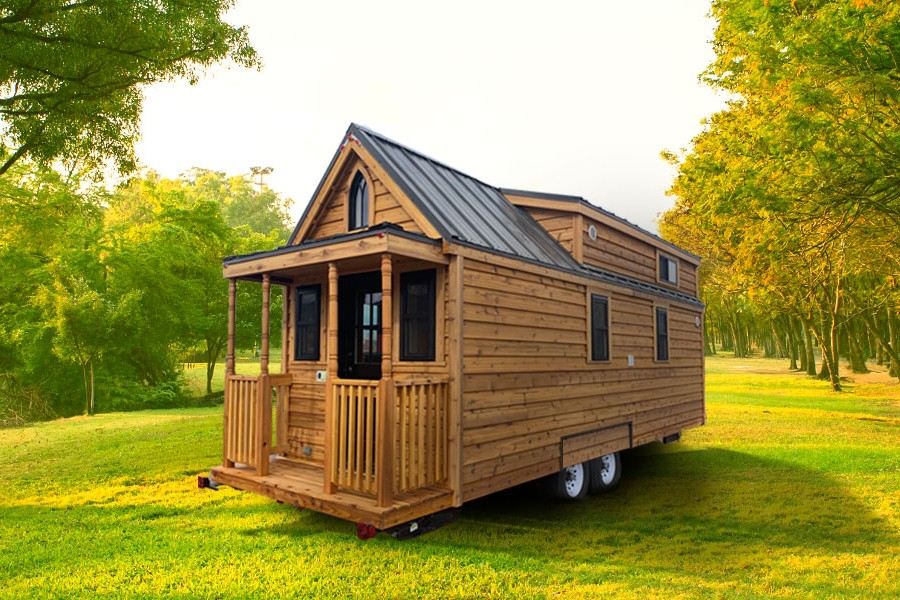
- Mobile: If you build a little house it can be moved when tenancy or purpose changes. It is not contained by a permanent foundation, but can be connected to a truck and towed to your new location and used again for the same purpose.
- Little Houses can be Sold Separately: When it comes time that you no longer need the additional space you can sell the little house separately from your real estate. It is easy to get back your investment, without completely selling your existing home to downsize. Or if you are living in this home and need to upsize because of additional family members, etc., you can sell it and migrate upwards.
These are five good reasons to buy a tiny house or space on wheels. Do you have other ideas or good reasons to do this? If so please use the comment section to give us your suggestions.
by Kent Griswold (Tiny House Blog)

Partner with Tumbleweed?
September 2, 2009
Want to sell the a Tumbleweed House from your store?
This summer Jay drove the Fencl across the USA as a show model. Now it’s time to sell. We will be promoting it for sale this September on our website. If we don’t sell it by the end of the month, we are looking to partner with a trailer / mobile home dealer to sell the house.
You should be near Connecticut and able to pick the house up. Currently the house is at Jay’s in-laws. [Read more]
Where should we go next?
September 2, 2009
Tiny House Toilet Options
July 30, 2009
Three Issues to think about when choosing a Toilet
When looking for a toilet to fill your needs in a tiny house, these are three issues to think about before you make your final decision. There may be other issues, but this will give you a place to start.
- Industry Standards a toilet that can be easily replaced upgraded and repaired.
- RV Toilets that I have seen upon initial inspection look and feel inadequate. That is, all of the ones I viewed at a local RV supply company mostly are plastic and don’t give the design appearance that I would like to have in a bathroom fixture. I have seen ones that have a ceramic bowl but with a plastic body/pedestal. If I may be subjective, They Are UGLY. I believe they include plastic due to the fact that if they were all ceramic that they would crack do to movement or deflection of the RV on the road and reduce weight. A very viable reason. Who wants to replace a toilet every time you move your RV. An option is to rough out the toilet drain stub-out 12″ from the back wall instead of the 11″ that RV toilets generally require so that way you have the option of installing a standard ceramic toilet or RV toilet. If an all Ceramic Toilet is used I would recommend that either you disassemble the Tank from the bowl during transport or provide some sort of Neoprene gasket to separate the two similar materials. If the two ceramic parts rub aggressively they could very well cause breakage and failure. I have not had experience of being on the road with a two part ceramic toilet. I would recommend removing the toilet during transport to be on the safe side. I would be interested in hearing other peoples experience. A one piece all ceramic toilet is another option, but once again, if I may be subjective, They are UGLY. One option for a small space is the American Standard Cadet 3 round front bowl with a Tropic tank made for the Cadet bowl. The best thing is to look and see what is available in your area in a small size and choose what you like the best for your home.
- Price. The toilets that I have seen as stated above don’t give offer the quality at the price points that I would like to see for myself. It is hard to justify spending more money on an RV toilet that is made of plastic. I have not done exhausted research on the RV toilets and I may be off base here. If there is a toilet that serves all of the benefits of durability during transport along with quality and pleasing appearance I would be more than willing to pay the extra cost.
I believe that most tiny houses will be spending more time stationary than on the road and at this point merits a toilet that functions well in that context.
I also believe in Composting toilets and that they can be as inexpensive and just as functional as standard flush toilets but they do require a level of responsibility to the user. This responsibility is a good thing. You can fashion a fully functional Sawdust toilet for as little as 10 dollars but this must be paired with a conscientious user. Local jurisdictions do play a part and most often side on the conservative for good reason. a good read on this topic is “The Humanure Handbook.”
This should give you some food for thought when looking at options for a toilet in your tiny house that you choose to build. As always comments and suggestions are welcome.
Kent Griswold publishes the Tiny House Blog
When is a Building Permit Not Required?
July 22, 2009
When is a building permit not required? How do I know what I can and cannot build? How do I find out this information?
This is a question I receive many times at the Tiny House Blog and I know it is something Tumbleweed home builders face when they make the decision to downsize to a Tumbleweed Tiny House.
First and most important thing to know is that each location is different, there are no set standards across the country so you need to check with your local County and City authorities. Thankfully much of this information is now online and you can do your research without talking to anyone.
I live in Sonoma County in Northern California. Here are the steps I went through to discover what the requirements were for building without a permit.
- I Googled “Sonoma County” and found their web site
- Than I did a searched on Permits on the Sonoma County website
- Clicked on Forms and Applications
- Found the form “When is a Building Permit Not Required?”
Not every county will be the same so this is just an example of how to start looking for the information. Here is the information I found doing this research:
WORK EXEMPT FROM A BUILDING PERMIT
The following is a list of work that may be performed without a building permit. If your project does notappear on this list of exempt work, you should assume that a building permit is required.
Note: Although some work is exempt from a building permit, additional permits or review may be required. Before a building or structure is erected, constructed, enlarged, altered, repaired, moved, improved, removed, converted or demolished, it is important to contact the appropriate staff at the Permit and Resource Management Department (PRMD) to determine if any other permit or technical review is required.
Although work may be exempt from a building permit, it may be subject to other county regulations (Well and Septic, Zoning, Drainage, Sewer, etc.). Although a building permit is not required, the exempt construction/work must be code compliant. For example, re-striping a commercial parking lot is exempt from a building permit, however, the striping must conform to building code standards for accessibility and Zoning standards for parking lot design. Failure to comply with code requirements may constitute a violation.
Building:
- Accessory Structures: One-story detached accessory structures used as tool or storage sheds, playhouses or similar uses when located on a parcel which contains an existing single family dwelling or other permitted primary use or structure. Such structures shall not have a floor area that exceeds 120 square feet and the height above grade shall not exceed 12 feet. No more than one structure may be allowed under this exemption unless separated from another permit exempt structure by more than 50 feet.
Note: Electrical, plumbing, or mechanical work in connection with such structures requires an electrical, plumbing or mechanical permit even though a building permit is not required for the structure itself.
To read the complete document go to When is a Building Permit Not Required?
This document tells me that I can build up to a 120 square foot structure without a permit. It can’t be higher than 12 feet and if I choose to put in electrical or plumbing I will need to get a permit for that only.
So technically I could build a Tumbleweed home that is less than 120 square feet on a foundation as long as it met these requirements. I would need a permit for the wiring and plumbing.
What if it is on wheels or considered an RV?
I was unable to find anything regarding this on the Sonoma County website. To my knowledge each town or neighborhood has its own rules regarding this. Some places allow you to park an RV at your home or on your property but only allow you to live in it for so much time and than you must move it. Others say it can only be parked but not lived in, and other areas don’t care one way or the other.
What About a Remote Area?
Often you can build in a remote area without permits. Here again it is important to check with your county requirements.
Many people just build and some areas are so remote that no one knows about your cabin or home. If you are reported by neighbors or someone else you may have to deal with the local codes and/or remove or tear the structure down.
Hopefully this article has given you some idea as to where to start looking for this type of information and also what to look for.
Comments and suggestions are appreciated.
Kent Griswold publishes the Tiny House Blog


Recent Comments