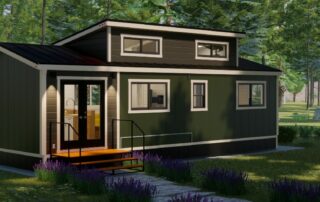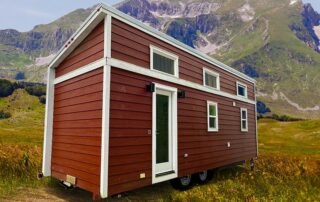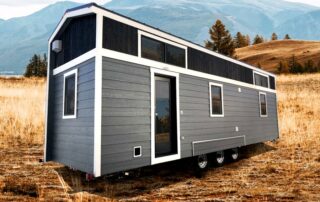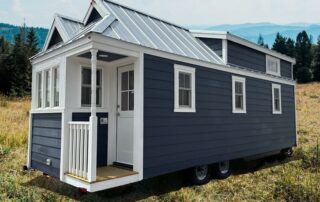
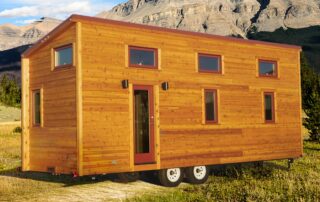
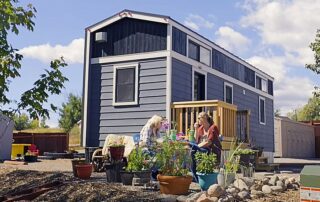
http://www.tumbleweedhouses.comWith wheels, traditional proportioning and archetypal form, these little structures are designed to be portable and can, essentially, be sited anywhere you can park a travel trailer.* They range from about 50 to 130 sq ft. Purchase yours ready-made or buy the plans to build it yourself. These homes are stationary designs built as a main house or guest house. Most of the plans have an optional extra bedroom in back. The house sizes range from 261 sq ft up to 874 sq ft. We do not build the Cottages. They are designed to be built on site with a local contractor of your choosing.Tumbleweed Tiny Houses CompanySteve Weissmannsteve@tumbleweedhouses.com
15 West MacArthur St95476SonomaCaliforniaUnited States
Storage set in to the wall is a great option. Enclose the
lower portion of the cabinet and leave the upper cabinet open to create the
feel of a larger space. Using glass shelving helps keep the feeling of the room
light.
Repurposing furniture is a great way to create more storage
and allows you to find something that specifically meets your needs. We
recommend using a marine varnish on wood furniture to protect it from moisture.
Keep your window treatments simple. If you can, avoid
curtains completely. Frosted glass provides privacy without clutter. If you
decide to use a window treatment choose a fabric that allows light to pass
through and cover only the bottom half of the window.
Proper ventilation of a small bathroom is a must! To save
energy and still remove moisture install a ventilation system with a timer. To
remove the heat and moisture the vent may need to be on for as much as an hour.
A timer allows you to leave it and not waste energy.
Create the illusion of more space by leading the eyes up.
Vertical lines on the walls or simple molding at the ceiling draws the eye
upward and creates the feeling of a larger space.
Fight clutter! Take your assessment of your storage needs
seriously and plan accordingly. Avoid busy or large patterns in your space.
Instead, accent a neutral pallet with bold color.
Design your lighting with your needs in mind. Florescent
lighting is energy efficient but can completely wash out natural color. Invest
in full spectrum florescent lighting to get the color and the environmental
benefit. Install both ambient lighting and task specific lighting. That task
might require a good strong light above the sink for shaving or applying
make-up or it might require warm lights with a dimmer for long leisurely baths.
Again, keep your needs in mind and design around them.
Pocket doors are incredibly handy in small spaces. The space
saved where the door would normally swing can be used for storage or simply
open space which is a luxury in itself.
Opinions on sinks are surprisingly strong among designers and there are so many variables
to consider. For the sake of this discussion we are going to look at a bathroom
that needs storage. Pedestal sinks are beautiful and keep a space open but when
storage is an issue they do not provide a solution.
Sink and vanity sets are available that are narrower than
the standard 21 inches. Some are as narrow as 16 inches. This allows you to
open up your space a little and still provides a place to store your towels.
Another model to consider would be a sink and counter
supported by four legs. This allows you to store baskets and towels while still
keeping your space open. Many manufacturers offer a “best of both worlds”
design with drawers below the counter top and open space below.
If space for the swing of doors in a below counter vanity is
an issue fabric curtains require almost no space and still hide your
unmentionables.
The countertop is a fun area to splurge if you can fit it in
your budget and you get a lot of bang for your buck. A beautiful marble
countertop can transform a room and it doesn’t care if it is mounted on a less
expensive cabinet system.
The vanity mirror can do a lot to extend your space. It
opens up your room and creates the illusion of a larger space. If possible,
keep your mirror close to flush with the wall. If storage is a consideration
the cabinet behind your vanity mirror can be built in to the wall.
A popular small space shower design is an “open shower”.
This design involves no shower walls or curtain – just the fixtures and a drain
on the floor. It is a great space saver! Having used showers like these before,
I feel it is important to note some serious drawbacks. Everything in the bathroom
can now potentially get wet – your towel, your clothes and, my least favorite,
the toilet seat. Safe, dry storage becomes nearly impossible. Successful open
shower designs are possible, but most that avoid the above mentioned issues are in
much larger spaces than those of our Cottage bathrooms.
If the goal is to keep the shower space from breaking up
your already small space there are other solutions. Glass shower walls or
curtains with ties that pull them back to the wall allow the eye to travel the
full length of the room.
Whether to include a bathtub in your small bathroom is a personal choice. When making that choice please be sure to consider that there are options for small spaces outside of the standard 5 ft tub. Corner tubs are a great space saver. Shorter tubs are also available by special order. When looking at a smaller tub there are a couple of things that become much more important. First, consider rim height. A common complaint is not the length of the tub but rather the fact that water, even in standard tubs, does not cover the bather. The other important thing to keep in mind is your “exit strategy”. How are you going to get out of the tub safely in your small space? Grip rails attached to studs in the wall are a must.
This bathtub was installed in a Harbinger.
To see more images of this cottage, click here.
To read about our small bathroom design tip on toilets, click here
Small bathroom design is a challenge for even the best designers. No other room in the house requires so much of so little space.
Considerations include toilet, sink, shower, storage, appearance, door
clearances and ventilation, all of which will be exposed to frequent use and
copious amounts of moisture. Bathrooms in American homes have doubled in size
in the last thirty years. Bathrooms in older homes average 5x8. Bathrooms in
Tumbleweed Cottages range from 4 ½ x 4 ½ for the smaller of two tiny bathrooms in
the Sebastarosa to 7 ¾ x 5 ½ for the single bathroom in the Whidbey.
The question then becomes how to get the most out of your
small bathroom. Who better to answer that question than Tumbleweed? As with any
space we recommend that you look at your needs first and then design with those
needs in mind. Who will be using this space? How much storage will they need?
Is a tub necessary or, for your needs, would that be wasted space? Finally, you
will need to know your budget and local codes. Once you make those
determinations the planning can begin.
Toilets:
There are several decisions to be made regarding the toilet fixture that you install. We are happy to report that environmentally minded regulations require low flow toilets on all new bathrooms or remodels. The question then becomes whether you want a gravity fed model or one with a pressure assist. Gravity fed models are less expensive however, they frequently need to be flushed multiple times to clear the bowl thereby negating some, if not all, of the benefits of purchasing a low-flow toilet in the first place. A toilet with pressure assist is more efficient and uses less water but the fixture is also more expensive. Although they have come a long way since first appearing on the market they do tend to make more noise – an important consideration in a small space.
Toilet shape is another consideration. Rounded bowls are more traditional and take less space. Elongated bowls, however, tend to be the norm in newer builds. The advantage of an elongated bowl over a rounded bowl is an increase in the surface area of the water. Toilets with elongated bowls designed for smaller spaces are available but must frequently be special ordered.