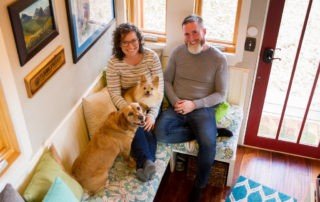
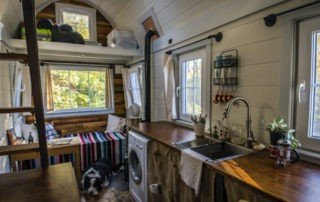
http://www.tumbleweedhouses.comWith wheels, traditional proportioning and archetypal form, these little structures are designed to be portable and can, essentially, be sited anywhere you can park a travel trailer.* They range from about 50 to 130 sq ft. Purchase yours ready-made or buy the plans to build it yourself. These homes are stationary designs built as a main house or guest house. Most of the plans have an optional extra bedroom in back. The house sizes range from 261 sq ft up to 874 sq ft. We do not build the Cottages. They are designed to be built on site with a local contractor of your choosing.Tumbleweed Tiny Houses CompanySteve Weissmannsteve@tumbleweedhouses.com
15 West MacArthur St95476SonomaCaliforniaUnited States
I was in the San Francisco area a few months back (a long, fun, haul for an East Coaster like me- what a town!), to shoot a few tiny housetours/episodes for my youtube show "Tiny Yellow House" and for content photos on a new book I've been working on, when I saw this! Its a Tumbleweed Fencl, RIGHT outside the gates of Muir Woods, at the parks maintenance and ranger station- how cool! The area was fenced in, and I couldn't get any closer, but I stopped my car, turned around, and snapped this photo:
Tiny Ranger House!
A lot of the photos I've taken on these trips are not only going to be in my follow-up book to "Humble Homes, Simple Shacks" but are being incorporated into a slide-show of inspirational tiny houses that is one facet of my presentations for the Tumbleweed Workshops that I teach around the country. This slide show presents some of the dos and don't of tiny house construction, and design approach, while also showing off some exceptional, clever, and bizarre deviations people have taken on the Tumbleweed plan designs- and beyond. Domes, Tree houses, Floating Homes, Tiny Houses built from Recycled Materials....they're all in there!
Kendra Pierre-Louis is a writer, researcher, environmental strategist, and author of the 2012 book Green Washed: Why We Can’t Buy Our Way to a Green Planet. Kendra wishes more people would hop on the small house bandwagon if not for the planet, than at least to cut down on housekeeping time. She can be found online and on Twittter.
Despite my
strong sustainability credentials, I sometimes feel unqualified to speak out on
the evils of big houses. There is no
priest nearby, so it is to you that I make this confession: although I
eviscerate the big house trend in my book Green
Washed I have never lived in a big house.
My current
home, a studio apartment in the New York City borough of Queens spans a spacious
220 square feet, somewhere in between the Popomo and the Bodega. My childhood home – which quite comfortably housed my
mother, father and older sister – clocks in at a mere 1,120 square feet. This
was totally normal square footage for 1955 when the house was built (though still
some 246 square feet larger than the largest of the Tumbleweed Tiny Houses,
but positively Lilliputian by modern standards. In 2010 median house size
spanned some 2,169
square feet (and that’s after three
years of house size deflation).
A view from Kendra’s favorite small house ever – a century old, single story house in rural Vermont
Did I mention these bigger houses
also house fewer people?
I confess this fact of my limited
exposure to larger homes because it’s easy for us of the small house clan to
rest on the intellectual superiority of our position. The science shows that smaller
houses require fewer materials to build, require less energy to heat and to
cool, and better coexist with the population densities that have been linked to
environmentally and socially sustainable lifestyles. And though, a
well-designed small house may cost more per square foot to build, they’re
cheaper to build and cheaper to maintain.
Check and mate, right?
And yet, lots of people love big
houses. As a relatively eco-aware friend once told me, “I grew up in a 4,000
square foot home and it was gorgeous – one day I’ll have a similarly sized
home.”
Why yes, we’re still talking.
Maybe, just maybe there’s
something we denizens of small abodes are missing.
Like the experience of being able
to talk to our family via intercom like one acquaintance I know who was raised
in a large sprawling home in suburban, New Jersey.
In contrast, when my mother
wanted me for something she was more old school – she hollered; imagine how
much her vocal cords could have been saved by a comprehensive intercom system necessitated
by big house living?
Here’s another benefit to big
houses– you can host a lot of people.
When a friend needed to host a
wide number of friends and family because of a family emergency, a family
friend was able to roll out the red carpet courtesy of not one, not two, but of
four guest bedrooms.
You never know when you’ll have
to host an entire basketball team on a moment’s notice.
Finally, let’s
not forget the absolute best thing that large homes afford us: the opportunity
to ignore our family members by never, ever, existing within the same space.
In grad school
I lived in a ramshackle cottage with questionable heat and plenty of
personality with two other roommates, and it was the first time I noticed this
curious trend. Namely, the less house per occupant – uniformly inhabited by
strangers who had agreed to live with each other sight unseen courtesy of my
grad school’s e-mail list serve – the closer the roommates became over time,
even when on the surface they shared nothing in common (i.e. bacon loving, pot
smoking, alcohol drinking atheists sharing a place with extremely devout, hijab
wearing Muslims). Small spaces are
intimate spaces and force us to get along or go our separate ways.
I’m not saying it’s not possible
to have these things in a big house.
It’s just harder.
And that, I think is the most
compelling argument for tiny houses isn’t an environmental one – but a social
one.