



Basic Answers about plumbing and electricity
How does the plumbing work?
All of our Tiny House RVs are plumbed to be connected to public water and sewer. The water comes in through a white RV hose, and leaves via an RV sewer valve (see pictures). A sewer hose would connect the RV to the sewer. In the event you aren’t connected to the sewer, we recommend a portable tank (or two) as seen on www.pplmotorhomes.com. Depending on your specific needs, we could include a standard, compost, or RV-type toilet. We recommend that you consult with a green building professional to help with green alternatives such as gray water systems, water catches, etc.
What is the setup for electricity?
It is easy — all of our small Tiny House RVs are wired for electricity and ready to be plugged in through a plug on the outside. It is up to you to determine the source of that electricity. You could power the RV using a standard AC plug-in, or even better, via a solar electric system with an inverter.
Appliances
What appliances are included?
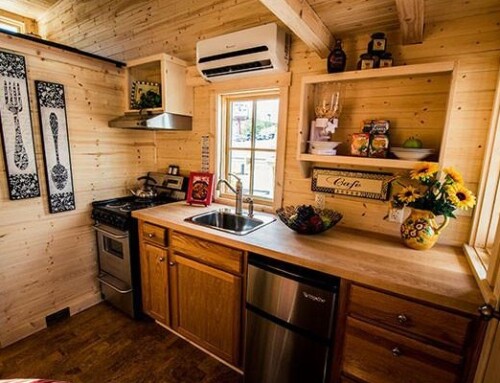
Everything you need is included in our Tiny House RVs. From the kitchen sink to the bathroom vent. The kitchen comes standard with a sink, fridge and cooktop. Add a microwave, oven or a washer/dryer based on your needs.
The bathroom comes with a sink, toilet and shower.
What about heating and cooling?
Tumbleweed Tiny House RVs are very well insulated, easy to heat and cool. Each Tumbleweed comes with at least two built in heaters. Air conditioners can be added to any Tumbleweed for an extra cost.



“our small Tiny House RVs are wired for electricity and ready to be plugged in through a plug on the outside. It is up to you to determine the source of that electricity. You could power the RV using a standard AC plug-in, or even better, via a solar electric system with an inverter.”
This is a bit vague. Please provide details for electrical power requirements (Volts/amperage/grounding) since I must select an appropriate off-grid solar power system. If possible, the full wattage required to run all amenities for a 200-250 sq. ft home. Please assume electrical appliances include 8-10000 BTU HVAC, H2O heater, oven, range, microwave, washer/dryer, refrigerator. Since this will be off-grid, please explain how the fuse box is grounded to earth ground. In other words, is there conduit or space provided within the tiny house walls to pass a 6 or 8 gage ground wire for your tiny house subpanel? Or does this need to be at the power source? Or both subpanel and power source to be grounded?